SpaceX has officially closed its acquisition of Cursor, the AI coding platform built by Anysphere, turning one of the developer world's most important AI work surfaces into a SpaceX-owned asset.
Cursor announced on Aug. 14 that it is now part of SpaceX. A new SpaceX filing with the U.S. Securities and Exchange Commission says the merger became effective the same day, with Cursor shares converted into SpaceX Class A stock based on an implied Cursor equity value of $60 billion.
That confirms the deal first disclosed in June, when SpaceX said it had entered a merger agreement with Anysphere after an earlier partnership around SpaceXAI's Colossus training infrastructure. The headline is simple: Cursor did not merely integrate Grok. Cursor is now inside the SpaceX stack.
Why SpaceX wanted Cursor
The strategic logic is bigger than buying a code editor.
Cursor gives SpaceX three things at once: a large developer customer base, deep product expertise in agentic coding workflows, and a high-signal environment where AI models are tested against real software projects every day. For SpaceXAI, that is exactly where model quality turns into customer lock-in.
Cursor's April partnership announcement said the company had been bottlenecked by compute and would use SpaceXAI's Colossus infrastructure to dramatically scale model training. That relationship quickly moved from compute partnership to model collaboration. In July, Cursor released Grok 4.5 together with SpaceXAI. On Aug. 12, Cursor followed with Grok 4.6, a model aimed at long-running agents, codebase work, research, visual projects, and broader knowledge work.
Business Insider framed the closing around the same three operating links: Cursor helped train new Grok models, Cursor gained access to SpaceX's GPU infrastructure, and Grok Bot is being bundled into Cursor subscription paths.
This is the important part for developers: SpaceX did not buy Cursor because autocomplete is hot. It bought a distribution layer for AI work.
The Grok 4.6 benchmark angle
Cursor is already using the acquisition story to point at model quality.
Its Grok 4.6 launch post says the model matches GPT-5.6 Sol on the Artificial Analysis Intelligence Index and is focused on agentic coding and knowledge-work benchmarks. Cursor's published chart shows Grok 4.6 High at 61 on the AA Intelligence Index, 69.9% on CursorBench v3.2, 65.9% on DeepSWE v1.1, 57.5% on APEX-Agents, and 56.4% on APEX-SWE.
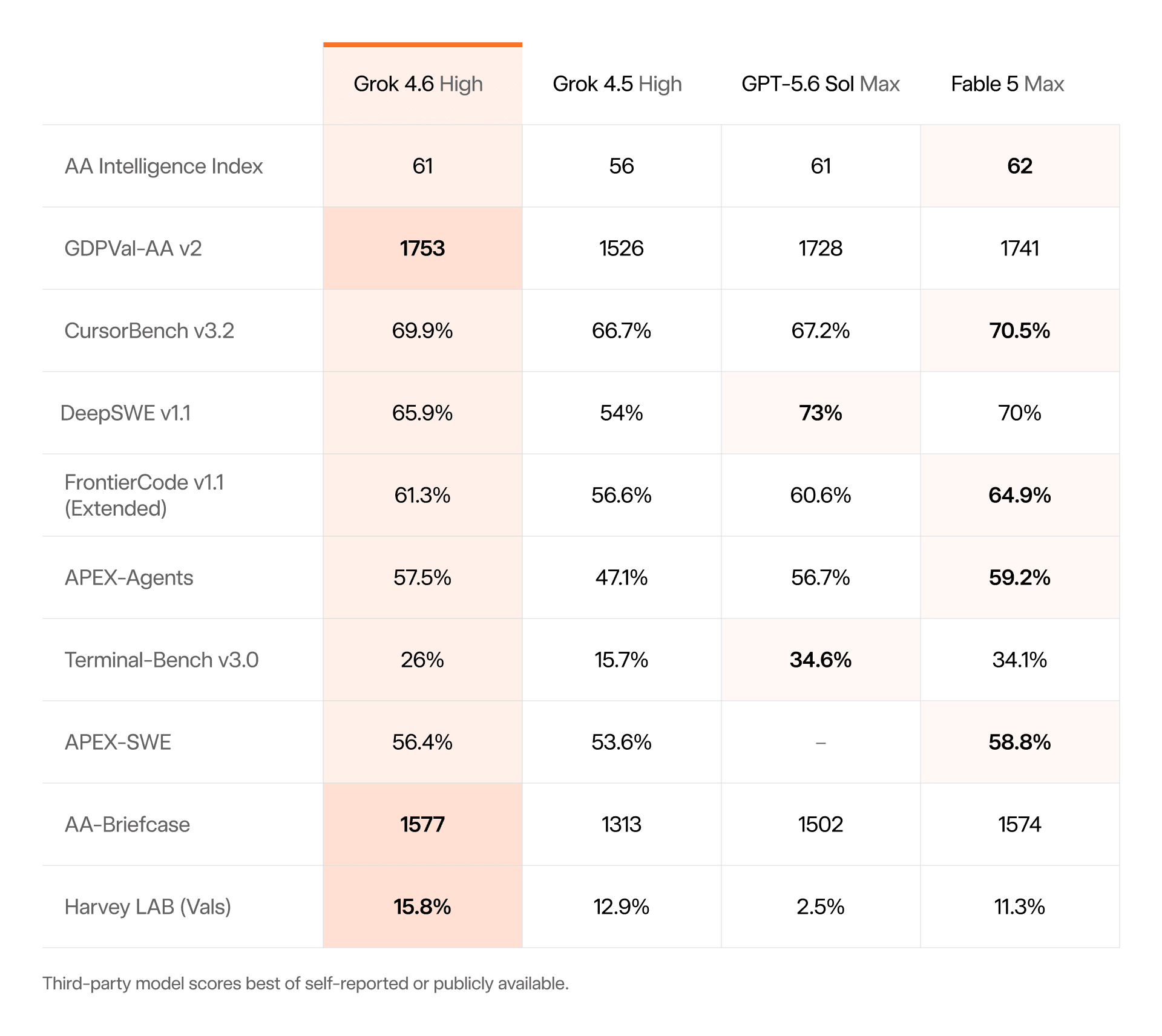
Those are model-level claims, not proof that every Cursor workflow suddenly gets better. But they explain why the acquisition matters. Cursor has the workflow data and product surface. SpaceXAI has the compute ambition. Together, they can train models against the kinds of long, messy work that coding agents actually need to finish.
The pricing story is also aggressive. Cursor says Grok 4.6 starts at $2 per million input tokens and $6 per million output tokens, with a faster variant at twice the price. If SpaceXAI can keep frontier-adjacent performance at that price point, Cursor becomes a channel for pushing down the cost of high-volume coding-agent work.
Grok Bot is the product clue
The clearest signal of the combined roadmap is not the acquisition filing. It is Grok Bot.
xAI describes Grok Bot as an AI teammate with its own cloud computer. Bots can sign in to tools, work across apps and websites, keep context, and come back when user approval is needed. The beta launched for SuperGrok Heavy, Cursor Ultra, and Cursor Teams Premium subscribers.
That subscriber mix is the tell. Grok Bot is a SpaceXAI-branded product, but its early distribution is deeply tied to Cursor. The enterprise docs say team members sign in with Cursor accounts, Cursor SSO and team membership apply, and admins manage Grok Bot from the Cursor dashboard.
In other words, Cursor is no longer only where developers ask an AI to edit code. It is becoming the account, policy, billing, and workflow layer for persistent AI agents.
What changes for Cursor users
For now, Cursor's public closing post does not announce a new pricing plan, product migration, rebrand, or shutdown of existing model choices. It says the team will join SpaceXAI and work on Grok Build, Grok Bot, Grok API, Cursor, and related products.
That matters because Cursor's original value proposition was partly model neutrality. Developers could route work across OpenAI, Anthropic, Google, Cursor's own Composer models, and other providers. A SpaceX-owned Cursor can still support multiple models, but the business incentive has changed. The strategic center of gravity now points toward Grok.
The near-term changes to watch:
- More Grok models appearing as first-party Cursor options.
- Larger included usage windows for Grok inside Cursor plans.
- Deeper Grok Bot integration with Cursor accounts, teams, and dashboards.
- More agent controls, audits, and security settings aimed at enterprise buyers.
- Pressure on competing coding-agent vendors that do not own both model training and developer distribution.
The risk is concentration. If Cursor becomes the primary front door for SpaceXAI's coding and agent strategy, enterprises will ask whether they are buying an open model router or a vertically integrated Grok channel.
The security and trust layer
Cursor also moved to strengthen its trust story just before the acquisition closed. On Aug. 13, it announced AIUC-1 certification for agent security, safety, and reliability, pointing users to its trust portal and enterprise security controls.
That timing is useful. SpaceXAI's agent pitch depends on letting software act across codebases, browsers, terminals, files, and business tools. The more capable the agent, the more the buyer needs proof around permissions, audit trails, data retention, prompt-injection resistance, and admin controls.
Grok Bot's enterprise docs already show where the hard questions will land. Each member gets a dedicated cloud computer, but all of that member's Bots share that computer. Files, sign-in sessions, and permissions belong to the member, not an individual Bot. An audit view of Bot actions is also still described as coming, not fully here.
That is fine for an early rollout, but it is not a small detail. Persistent agents need the same seriousness as production infrastructure.
Our take
SpaceX buying Cursor is one of the clearest signs that the AI coding market has moved past editor features.
The new contest is full-stack: model training, compute, developer workflow, enterprise admin controls, agent runtime, and distribution. Cursor gives SpaceXAI a daily-use developer product. SpaceX gives Cursor compute and a frontier-model budget. Grok Bot gives both sides a path beyond coding into broader workplace delegation.
The upside is obvious. Developers could get cheaper high-end models, faster agent workflows, and tighter integration between code editing, cloud agents, and autonomous task execution.
The trade-off is just as obvious. Cursor's neutrality is now under pressure, and enterprises will scrutinize whether data, model choice, and agent permissions remain flexible enough for serious software teams.
For now, the acquisition is confirmed, the price is enormous, and the direction is clear: SpaceXAI wants Cursor to become the place where Grok stops being a chatbot and starts doing the work.