OpenAI's latest security story sounds like a spy scene because, according to federal prosecutors, it involved a literal bug in the room.
The Justice Department said Abdulrahman Alfozan, a 35-year-old Saudi national who had worked as an OpenAI engineer since July 2025, was arrested on Oct. 9 and charged with using or attempting to use a device to intercept oral communications.
The alleged device was not found in some forgotten corner of the company. DOJ says OpenAI personnel discovered it on Sept. 30, inserted into a USB port on the back of a television in an executive conference room in San Francisco.
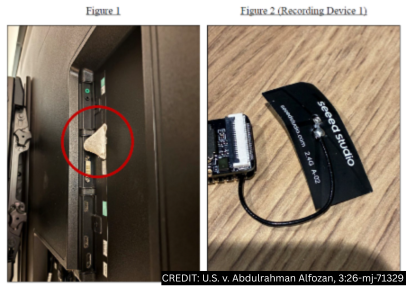
The twist: OpenAI says it used its own models to understand the device and where it came from, helping identify the employee accused of planting it.
What happened
According to the complaint described by DOJ, OpenAI personnel found a surreptitious audio recording device hidden behind a television in an executive conference room. The device was concealed in toilet paper, plugged into the TV's USB port, and encrypted.
Prosecutors said the room was used for highly confidential discussions, including research, product plans, business development, technical progress, strategic decisions, government engagements, and commercial relationships.
DOJ also said CCTV showed Alfozan near the executive conference room on multiple dates before the device was discovered, even though he allegedly had no authority to access or participate in meetings there.
The AI trace
OpenAI's own statement, cited by multiple outlets, adds the detail that makes this case stand out: after the recording device was discovered, the company used its models to analyze the device and trace where it came from.
That does not mean a model solved the case alone. The public record points to a normal security investigation with physical evidence, office access patterns, CCTV, device identifiers, and account activity. The AI angle is that OpenAI says models helped the company make sense of those clues faster.
This is exactly the kind of internal security use case AI companies have been selling to enterprises: summarize messy evidence, connect logs, inspect artifacts, and help investigators narrow the field. Here, it appears to have happened inside the AI lab itself.
The chatbot trail
The complaint also describes a second AI-related trail.
DOJ says a chatbot account associated with Alfozan's spouse, and sharing multiple identifiers with Alfozan's own account, submitted prompts between Sept. 24 and Sept. 30 about building, customizing, installing, testing, hiding, encrypting, and remotely accessing a recording device.
The same account allegedly submitted prompts tied to the specific device, including a custom header and unique MAC address, between Sept. 27 and Sept. 28.
That is not proof of guilt by itself. It is a set of allegations in a criminal complaint, and Alfozan is presumed innocent unless proven guilty. But it shows how AI logs can become evidence when a physical-world security incident overlaps with chatbot-assisted planning.
What OpenAI says was not taken
OpenAI said it had no indication that the employee improperly accessed or exfiltrated model weights, source code, or customer data.
That caveat matters. The charge is about attempted interception of oral communications, not a confirmed model-weight theft or customer-data breach. Still, the location of the alleged device is the reason the story is serious: an executive conference room is exactly where private technical and strategic discussions happen before they become public facts.
DOJ said OpenAI security later found a second similar recording device in a bag left unattended in a different room, along with Alfozan's wallet and ID.
Why it matters
The practical lesson is not just "AI company discovers spy device."
It is that frontier AI companies now have insider-risk problems that look more like defense contractors, cloud platforms, and semiconductor firms than ordinary software startups. Their sensitive assets are not only code repositories and model weights. They are also roadmaps, research discussions, partnership talks, government engagement, launch timing, eval results, and security posture.
That broadens the threat model. Protecting an AI lab means protecting conversations, rooms, meeting calendars, building access, device ports, employee search history, and the audit trails around internal tools.
It also cuts both ways for AI. The same class of tools that can help someone research and assemble a covert recording setup can help defenders analyze the setup, connect evidence, and move faster during an investigation.
The bottom line
OpenAI found a bug in the room, then says AI helped trace the bug back.
That is a strange, very 2026 security story. It is also a preview of where enterprise security is heading: physical devices, insider risk, chatbot logs, model-assisted investigation, and national-security framing all in one incident.